Richard Hards
‘Strangeways’
3 October to 4 December 2026
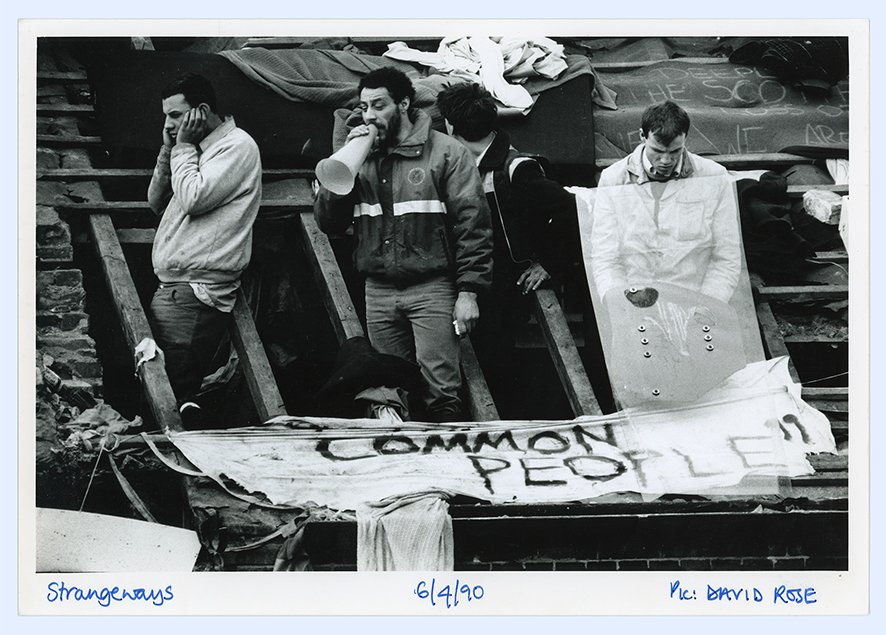
Richard Hards’ autumn 2026 exhibition at Moon Grove brings together moving image, sound, and archival photography developed through the artist’s sustained research into the 1990 Manchester Strangeways Prison protest. Emerging from his doctoral project, ‘Reasonable men might have acted likewise’[i], the show takes as its starting point a recording made during the prison’s Sunday service, immediately before the protest began.
The circumstances of this document are significant. On 1 April 1990, around 300 prisoners were assembled in the Strangeways chapel for Sunday service. A visiting speaker had just delivered a sermon when a prisoner, Paul Taylor, took the microphone and began addressing the congregation. The Prison Reform Trust describes Taylor as delivering his ‘own sermon’, calling for resistance and reform, reusing words from the address to rebuke the prison system. As the service was being recorded by Rev. Noel Proctor, the prison chaplain — reportedly for distribution to a prayer group — the beginning of the disturbance was inadvertently captured. Proctor subsequently submitted the tape to the Home Office as evidence for the prosecution of protesters. Only the section considered useful as evidence survives in transcript: the choir, guest sermon and chaplain’s solo are absent.
Hards has spent several years attempting to locate the soundtrack; having passed from the Home Office to the Ministry of Justice, it may remain in government storage or have been destroyed under records-retention procedures. Its existence remains uncertain. The missing tape subsequently becomes a kind of MacGuffin[ii] for the exhibition: an absent object that remains persistently out of reach while driving Hards’ research. The artist’s search has generated an accumulation of other material – released documents, photographs, transcripts and memorabilia, alongside freedom of information requests – through which a wider history of the protest and its representation emerges.
A new sound work, Strangeways Prison Chapel, April 1st 1990 (2026), situated in the living room at Moon Grove, re-enacts the surviving partial transcript through the voices of a protesting prisoner, and the Reverend and prisoners shouting elsewhere in the chapel. Rather than reconstructing the service, it draws attention to what was preserved as evidence, what was discarded and the institutional decisions that determined the difference. Elsewhere, archival press photographs are enlarged across tiled sheets; taken from outside the prison by photographers unable to enter the site, their distant viewpoints break down into grain, dots and seams. The images include men occupying the prison roof; a banner reading ‘NO DEAD’, produced while conflicting reports circulated about fatalities inside; negotiations between prisoners and officials across different rooftops; and Alan Lord, a participant in the protest, shouting through a loud hailer made from a makeshift cone.
Lord, one of the most prominent participants in the protest – who from the roof, made the politics of the protest visible, writing messages of resistance on banners and blackboards and holding the prison governor’s records up to press photographers as evidence of conditions inside – is the focus of a new moving-image work, Reasonable men might have acted likewise (2026). He received a further ten-year sentence for his involvement in the campaign and remains on life licence. Made with four directors of photography, the film resists the conventions through which he has previously been represented in documentaries, where brief extracts from interviews have tended to be lit, edited and scored to produce a threatening figure. Instead, Hards constructs an extended conversation in which his collaborator looks at and describes archival photographs, watches television footage of Strangeways and, elsewhere, simply walks through a forest, temporarily detached from the archive and the event through which he has repeatedly been represented.
Hards’ work also traces the peculiar afterlife of the Strangeways protest through objects circulating beyond official archives. ‘Operation Bastille’ was the code name for the police investigation; decades later, Hards discovered commemorative badges relating to the event being sold online, including one bearing the word ‘BASTILLE’. Enlarged and reproduced for the exhibition, they point to a history surviving simultaneously as evidence and memorabilia. There is something combative about this insignia: police officers and prison wardens appear transformed into an antagonistic tribe, with institutional authority becoming an emblem of belonging. An exercise of state power acquires the character of a private club, its violence distanced and even glamorised through its own sinister relics.
Importantly, in 2026, this exhibition takes place within a city changed almost beyond recognition since the events of 1990[iii]. The Manchester against which the Strangeways protest unfolded has been progressively remade through more than three decades of private regeneration and property speculation, frequently marketed through an appropriation of the cultural imagery and language of the industrial North itself: think L. S. Lowry and Tony Wilson turned anarcho-capitalist. From the redevelopment of the city centre and Salford Quays to the transformation of Ancoats, New Islington and the northern edges of the centre, the industrial remnants visible in images of the city now stand in stark contrast to the glass towers and computer-rendered surfaces of the contemporary city, a reality that can appear almost AI-generated in its transformation of the skyline, suggesting a sci-fi reconstruction redolent of the urban landscapes of J. G. Ballard.
In recent years, the area around the prison has also acquired the unofficial name the ‘Strange Quarter’, associated with a loose cluster of independent venues including the White Hotel, Hidden, DBA and the Yard. Occupying former industrial buildings and overlooked spaces, they have collectively created a distinct cultural ecology in an area long defined by industry, the prison and neglect. Yet, in an all too familiar pattern of urban expansion – from Chelsea in Manhattan to east London – this activity has itself begun to attract the interest of developers and local government. In August 2026, only two months before Hards’ exhibition opens, property developer Salboy used the name ‘The Strange Quarter’ to describe an imminent 130-hectare redevelopment north of Victoria Station: the conditions that allowed these spaces to flourish are now helping to make the area attractive for large-scale development. Thirty-six years after the prison protest, ‘Strangeways’ reflects on an area whose history, identity and even name are once again being rewritten.
While the prison that dominated images of Manchester in 1990 remains physically present, the city around it is becoming increasingly difficult to reconcile with those photographs. Hards’ archival images consequently record more than the protest: their distant rooftops, industrial buildings and interrupted skyline also preserve a Manchester that has largely disappeared.
Ultimately, ‘Strangeways’ brings together material according to the uneven ways in which the protest has survived, reflecting in turn the changing nature of the city: records retained because they were useful to the state; photographs produced from outside the prison; objects subsequently circulated and sold; a partial transcript of a recording that may no longer exist; and the testimony of someone who was there. Rather than reconstructing the events of April 1990, Hards uses these forms of evidence to examine who is allowed to produce and preserve an account of an event, what is permitted to disappear and what happens when those accounts return to circulation. The missing recording remains at the centre of the exhibition. Hards is still looking for it.
Richard Hards (born Bermondsey, London, 1985) lives and works in Deptford, London. He studied Fine Art at Goldsmiths and Sculpture at the Royal College of Art and is currently completing a PhD in Fine Art at Kingston University. His sustained engagement with the prison system draws on both personal and professional experience, through family members who have experienced imprisonment and his work as an academic mentor with people who have been in prison. His multidisciplinary practice encompasses moving image, installation and sound.
Notes:
[i] The title 'Reasonable men might have acted likewise', comes from a case that preceded the Strangeways protest. On 1 May 1989, prisoners at Risley Remand Centre took over a wing and spent three days on the roof, a year after the Chief Inspector of Prisons had described conditions there as ‘barbarous and squalid’. The Home Secretary told the Commons that those shortcomings provided no justification for the violence. At trial the following year, twenty-one men argued that conditions amounted to false imprisonment and entitled them to use reasonable force. The judge directed the jury to disregard the argument. The jury acquitted them all. The phrase is taken from the argument made on their behalf by their legal representative. The Strangeways prosecutions that followed ran across several trials and turned increasingly on conspiracy charges, under which the conduct of the group rather than the acts of the individual was what had to be proved.
[ii] The MacGuffin is associated particularly with Alfred Hitchcock, the term describing an object or piece of information whose pursuit sets a narrative in motion, even as the search becomes more significant than the thing being sought.
[iii] The protest unfolded against the wider political unrest of 1990. The mass anti-Poll Tax demonstration in Trafalgar Square had descended into violence only the previous day, and participants at Strangeways subsequently claimed that the Home Office deliberately allowed negotiations to drag on, enabling the spectacle of prisoners occupying the roof to displace the Poll Tax revolt in the public imagination. Whether or not this was the case, the coincidence suggests a striking shift in representation: from a political crisis confronting Thatcher’s government to a spectacle increasingly organised around criminality, disorder and individual prisoners.